Our life inside
We spend 90 percent of our time indoors. On average—sometimes even more. At home, at the office, in public facilities, we are constantly indoors. And while we often focus on the air outside, we rarely think about the quality of indoor air. However, pollutants in outdoor air—such as particulate matter, nitrogen oxides, or volatile organic compounds—can easily enter indoor spaces, and if not filtered, they can have a significant impact on our health and well-being.
Particulate matter is particularly harmful to our health. Particulate matter is a collective term for small particles in the air with a diameter of less than 10 micrometers (µm). Although these particles are invisible to us, they pose a major threat to our health. This is because the smallest fine dust particles can enter our throat, lungs or, if they are small enough (1 µm), even our bloodstream.
Polluted air, sick people: The health consequences of poor indoor air quality
Indoor air pollution poses a number of health risks that can have both acute and chronic effects. Acute symptoms include headaches and fatigue, while chronic effects include allergies caused by pollen or mold spores, and respiratory diseases such as asthma and COPD. All of these can be caused or exacerbated by particulate matter or volatile organic compounds (VOCs).
Small particles in particular (especially PM2.5, i.e., particles smaller than 2.5 μm) have long been associated with an increased risk of heart attack and stroke. Long-term exposure to air pollutants such as certain volatile organic compounds is also associated with an increased risk of cancer.
Poor air quality has consequences for the world of work
Poor air quality and its consequences for our health also have an impact on the world of work. Poor indoor air quality reduces employee well-being and leads to lower productivity and an increase in illness. This places a significant burden on the healthcare system and represents a major loss for businesses. Of course, the loss of productivity does not only affect workers. Air quality also affects children's ability to learn at school. This has a long-term impact on their educational opportunities.
Overall, the consequences of indoor air pollution can be significant and affect both physical and mental health. Therefore, measures to improve indoor air quality, especially in offices, schools, and healthcare facilities, should be a priority. High air quality is essential for performance and overall well-being.
Solution: Air filters ensure clean indoor air
Properly designed and optimized ventilation and air conditioning systems (HVAC systems) are a good method for improving indoor air quality. These filtration systems effectively remove particles such as dust, pollen, and mold spores from outdoor air, thereby contributing significantly to healthy indoor air and a pleasant indoor climate.
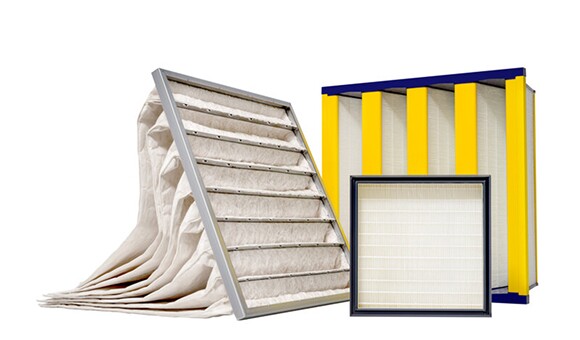
HVAC systems often use several classes of filtration with different efficiencies and filter configurations. Air filters such as pocket filter cartridges, filter fleece, panel filter cartridges, and cassette filter cartridges are used for coarse and fine dust filtration. Special air filters, such as HEPA or ULPA filters, can filter bacteria and viruses from the air—a crucial factor in hospitals or other environments with a high incidence of viruses and bacteria.
Activated carbon filter cartridges bind unpleasant odors and pollutants such as volatile organic compounds that arise during everyday production. These air filters ensure better air quality at airports or even in restaurants and commercial kitchens.
In buildings without a central ventilation system, air purifiers can be used to effectively clean the air of pollutants and particles. These devices can also filter bacteria or viruses from the air
Hengst air filters: Energy-efficient air filters for clean indoor air
Hengst Filtration offers a comprehensive range of standard and special filters for commercial, industrial, and residential spaces. Thanks to the large number of possible variants, our customers around the world can find the right solution for every project.
Our portfolio of air filters for HVAC systems includes many energy-efficient air filters. In this way, we support operators and facility managers in ensuring the long-term profitability of their systems thanks to low energy consumption and thus lower operating costs.
Our energy-efficient air filtration systems for ventilation systems are certified by Eurovent's ECC program. Our air filters are classified in energy classes from A+ to E in accordance with the ISO 16890 filter classification. The most energy-efficient air filters are classified in the highest category, A+.
For more information about indoor air quality and our products, please contact our representatives.